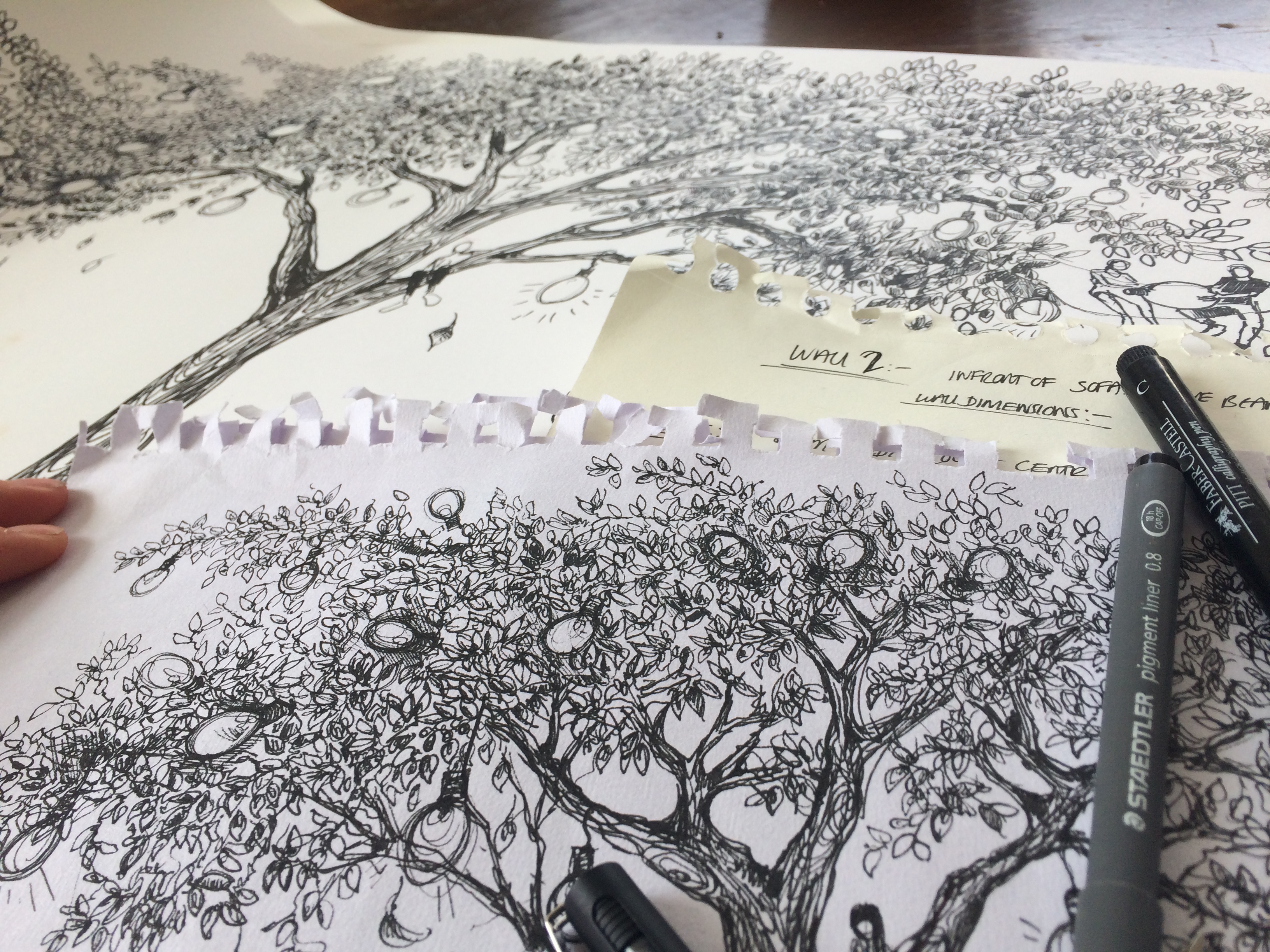
A little over a month ago, I began a residency at Pervasive Media Studio. The first thing I was drawn to was conductive ink.
Before this it was never something I’d been exposed to or seen used much in the world of creative tech and digital art, but the idea to use it stemmed from one of my first meetings I had here. The main focus of my residency is exploring ways I can use creative tech elements in my practise, such as animation, VR, and everything else. Conductive Ink jumped out to me because it still holds so many of the traditional illustration methods, it is literally a paint which you can apply onto a surface with a brush- but it conducts electricity and responds to your touch.
I looked into a mural called ‘Ambient Play’, which featured large scale artworks that pan across multiple walls in a white room. When you touch the artwork in particular places, sound or light is triggered. This is done by instead of using regular black ink to create the artwork but by using conductive ink instead- ink that conducts electricity. To do this you need a touch board- which has around 10 different sensors, conductive ink, and for the two to connect. You can use tape and other materials-as long as they are conductive- to ensure that your artwork is connected to the touch board which is where the sound or light elements are triggered.
First of all I began experimenting. The main aim of my time here is looking at storytelling in all it’s forms- how i can use creative technology to delve into new ways of telling a story, incorporating touch, sound & light. My work so far has relied on only visual elements, sound isn’t something i’ve ever incorporated before so was a big area of exploration for me. My illustration work often acts as a platform for peoples voices and stories, and in the past the only way i’ve ever tried to convey these messages is by using text. What if i could create the same kind of work, illustrations of people and places and particular environments, but when you touch the artwork it triggers audio of the person talking? What about if you touch the cars in the background of the image, you can hear traffic? I was excited to explore ways you can build up the feeling of a place and really immerse yourself into someone’s story and environment by combining visual elements with sound, or even light.
Bare Conductive are a huge supplier or materials objects and tools that can all help make this kind of project happen, and to start with I had a tub of conductive ink paint, a paint ‘pen’ (essentially a small squeezy tube with paint in it), touch board, alligator clips, and tape. I just wanted to see what worked and what didn’t. Painting with conductive ink is actually pretty difficult. The paint is really thick and gloopy, it doesn’t run easily or allow you much control over it in the state you buy it in. Diluting the paint is an option and you can do that by adding water, like you would normal paint. The only thing about this is it can affect how easily it picks up your touch and actually sends signals to the touch board. Diluting the paint makes it thinner and therefore less conductive. As does painting with thin intricate lines. I found the thicker i laid on the paint, the quicker and easier the touch board was triggered- which is pretty obvious stuff.
I think learning ways to dilute the paint so its more accessible and easy to use for artist’s is something I really want to focus on over the coming weeks. The paint pen makes things slightly easier, but as it’s in a tube, trying to squeeze it out and maintain a high level of control is really tricky and requires a lot of patience. It’s not an ideal applicator and definitely not great for creating work of high detail. If there’s a way i can develop a specific tool that will allow me, an illustrator, to use this material freely how i would normally draw, would be really beneficial.
Printing in conductive ink is also an option I’m looking to explore- the ink can be used in screen printing, which would mean I wouldn’t need to worry about messiness or applying an incredibly gloopy ink onto a crisp clean white surface, however would probably rule out the option of doing murals. There’s something i enjoy about hand-drawing my pieces, so opting for screen-printing as a replacement would mean sacrificing a lot of elements in my practise that I really value.
Another thing I was considering a lot is how to hide the tracks from the illustration to the touch board on something like a mural. The two need to connect to make a complete circuit and in order for the sound to work, but it’s important to me to do this discreetly, so it’s not a distraction from the artwork. But, depending on the surface, some are thin enough or made from the right material and are actually conductors, so will allow you to have the tracks running down the back of the surface and connect to the touch board on the back of the piece. So you can hide all of the techy stuff around the back, which is great.
Another thing I am looking at finding a way around, is insulating layers. You can apply paint like acrylic to the surface of the conductive ink and it still conduct through it, which means I can add colour to my pieces without worrying whether it will sense my touch through the layer of acrylic or not. But finding a good insulator has taken a lot more research and experimenting. For instance, say I paint a house and in front of it i want to paint a tree, but I need them to be part of different circuits and trigger different sounds. The moment the paint from the tree touches the paint from the house, it will be the same circuit and therefor trigger the same sound. I need to find a way to put a layer in-between the tree and the house so I can ensure they remain separate elements. Latex is a good insulator, and you can purchase paint relatively easy. But this was something super important for me to keep in mind if I plan in creating elaborate and detailed worlds using these materials.
One thing i’m struggling with- using Arduino. Arduino is software you download onto your computer that allows you to operate the touch board. Through Arduino you can programme different sounds onto the touch board, which has around 10 sensors and you can programme each one to play a different audio. The software involves a lot of code, and you need to know exactly where to enter your code into in order to make the alterations you want. I find technology elements the more difficult things to get my head around when it comes to these projects, but it’s worth spending a lot of time playing around with it and watching Youtube tutorials, which do help a lot.
These are my first thoughts, ideas and hurdles I’ve had during the initial stage of experimentation and research in conductive ink. Many many more to come, I’m sure.
Any advice or thoughts are always welcome and appreciated, do hit me up.

 Jazz talking about all things creative tech.